
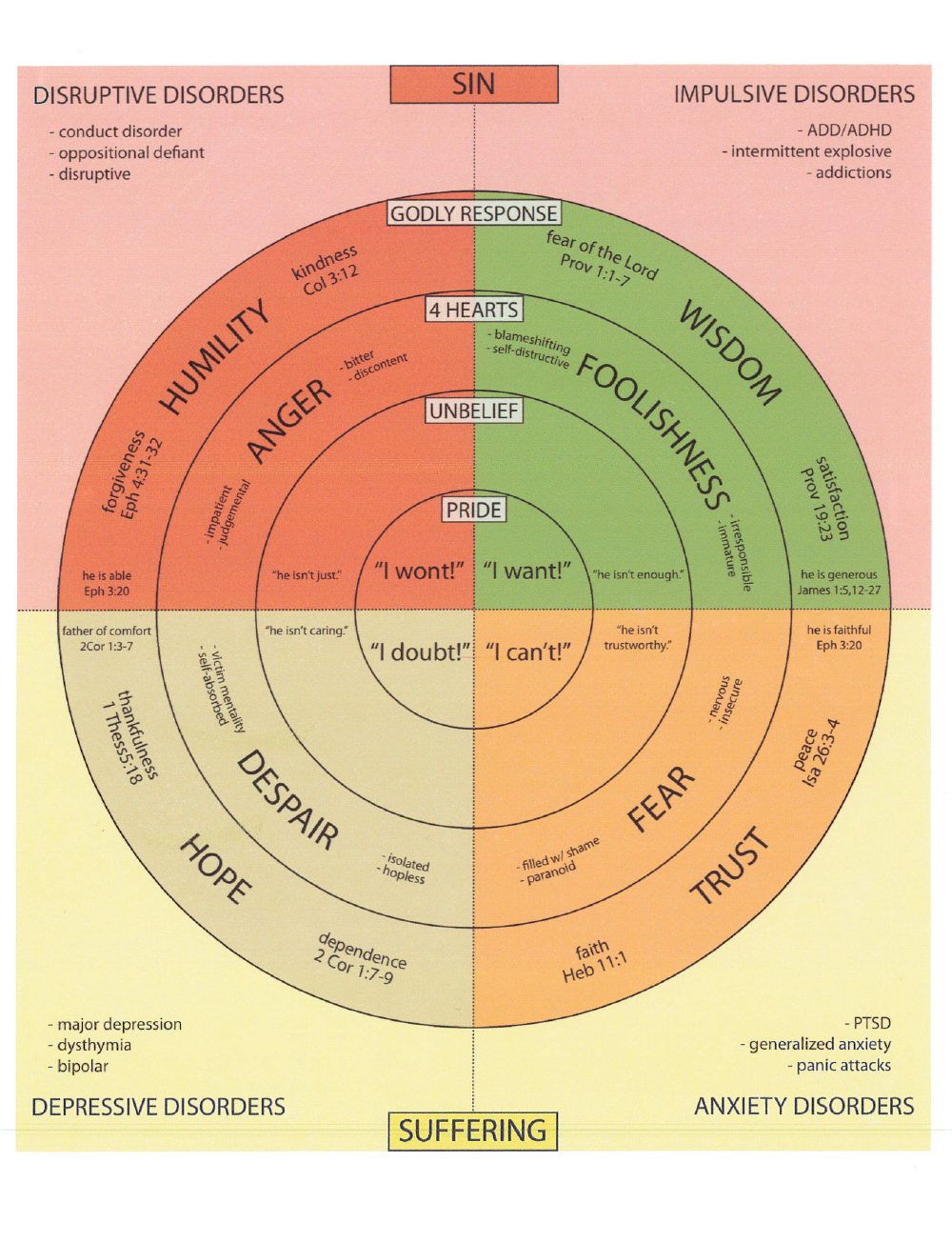
The Four Hearts Framework
| Heart Pattern | Flesh Statement | Unbelief | Common Patterns | Renewed Response | Godward Anchors |
|---|---|---|---|---|---|
| Anger | “I won’t!” | “He isn’t just.” | impatient; judgmental; bitter; discontent | Humility: humble, submissive, tender, kind | He is able (Eph. 3:20); forgiveness (Eph. 4:31–32); kindness (Col. 3:12) |
| Foolishness | “I want!” | “He isn’t enough.” | blameshifting; self-destructive; irresponsible; immature | Wisdom: reverent fear, seeking wisdom, satisfaction in Christ | Fear of the Lord (Prov. 1:1–7); satisfaction (Prov. 19:23); He is generous (James 1:5, 12–27) |
| Despair | “I doubt!” | “He isn’t caring.” | victim mentality; self-absorbed; isolated; hopeless | Hope: hopeful, thankful, dependent | Father of comfort (2 Cor. 1:3–7); thankfulness (1 Thess. 5:18); dependence (2 Cor. 1:7–9) |
| Fear | “I can’t!” | “He isn’t trustworthy.” | nervous; insecure; filled with shame; paranoid | Trust: trusting, loving more than needing, peace in Christ | He is faithful (Eph. 3:20); peace (Isa. 26:3–4); faith (Heb. 11:1) |
The original diagram places anger and foolishness under sin, and despair and fear under suffering. It associates disruptive disorders with anger, impulsive disorders with foolishness, depressive disorders with despair, and anxiety disorders with fear.
Four Hearts Common Heart Themes
| Flesh Bent | Flesh Statement | Flesh Question | Renewed Statement | Renewed Question | Renewed Heart |
|---|---|---|---|---|---|
| ANGER — Torch Lighter (Isaiah 50:10) | “I deserve it!”; “My will be done”; “I won’t!!!” | “Is God just?”; “How do I get respect?” | “Christ is my Lord”; “His will be done”; “He judges justly” | “Who have I offended?”; “How do I reconcile?”; “Who do I need to forgive?” | Humble, Submissive, Tender, Kind |
| FOOLISHNESS — Broken Cisterns (Jeremiah 2:13) | “I want it now”; “I can’t help myself” | “Is God really enough?”; “How can I get more?” | “God is worthy and awesome”; “God is sufficient” | “What can I own?”; “Who can I bless?”; “Can I wait upon Him?” | Reverent Fear, Seeking Wisdom and satisfaction in Christ |
| DESPAIR — Vain Striver (Ecclesiastes 2:20) | “I’m misunderstood”; “No one knows my pain”; “I doubt…” | “Is God compassionate?”; “Does anyone really care?” | “God is compassionate and near”; “I am in His sovereign hands” | “Where is my hope?” | Hopeful, Thankful, Dependant |
| FEAR — Man Pleaser (Galatians 1:10) | “I am unlovable”; “I can’t…” | “Is God trustworthy?”; “Does anyone like me?” | “I trust God with all my heart”; “My esteem comes from Christ’s love” | “Who have I needed that I need to love more?”; “With Christ as my friend who shall I fear?” | Trusting, “Loving more than needing”, Peace in Christ |
Anger
The person characterized by an angry heart has a propensity to make an idol of power, control, and self-sufficiency or to be covetous. This person might find themselves making conscious and/or unconscious statements like, “I want respect or peace…!” or “I can’t believe so and so…!” A person who chooses not to deal with an angry heart may be characterized by bitterness, judgment toward others, discontentment, and lacking joy. Others might comment that their actions are volatile, ungrateful, condemning, grouchy, irritable or difficult.
Foolishness
The person characterized by a foolish heart has a propensity to make an idol of escape, pleasure, or self gratification. They may find themselves constantly in the pursuit of certain feelings, objects or the accumulation of things. This person may find themselves making conscious and/or unconscious statements like “I want it now!” or “I just can’t help myself!” The person who chooses to not deal with a foolish heart may be characterized by consuming addictions, blame-shifting, irresponsibility, and self-destruction. Others might comment that their actions are irresponsible, lazy, selfish or immature.
Despair
The person characterized by a despairing heart has a propensity to make an idol of easing pain, feeling good, and creature comforts. This person may find themselves making conscious and/or unconscious statements like “I deserve!” or “I’m totally helpless!” The person who chooses to not deal with a despairing heart may be characterized by a victim mentality, an inordinate need for security, self-pity, strained relationships and a propensity to self-medicate or escape through fantasy or self destructive behavior. Others might comment that their behavior or moods are melancholy, or down in the dumps, when relating to others they are often distant, isolating, draining, or self-absorbed.
Fear
The person characterized by a fearful heart has a propensity to make an idol of security, perfection, or looking better than they are. This person may find themselves making conscious and/or unconscious statements like “Will they reject me?” or “I can’t risk it!” The person who chooses to not deal with a fearful heart may be characterized by false guilt and shame, social and/or spiritual paralysis, fear of man, and a shaken faith. Others might comment that their behavior or moods are up and down, nervous, tentative, and their social interactions are sometimes avoidant, or paranoid in nature.